
Visiting the Intrepid Museum in 2026

A taxi drives past the USS Intrepid Museum on the west side of Manhattan. Photos by John O’Boyle / The Empty Nest Explorers
Updated April 2026
The USS Intrepid is perfectly located in midtown Manhattan for a few-hour visit during a trip to New York City.
The Intrepid Museum was founded in 1982 with the acquisition of the legendary aircraft carrier USS Intrepid. The carrier has been joined by the Space Shuttle Enterprise, a British Airways Concorde supersonic aircraft, a submarine, and 28 restored aircraft.
That’s a pretty good lineup, even if you are not particularly interested in aviation history. I suppose that’s why over a million people visit each year.
I have had a bit of an obsession with aircraft carriers since my days as a newspaper photographer. I had the opportunity to land on the USS John F. Kennedy. It was an “arrested landing” where the plane’s tailhook catches a cable on the deck, and in an instant, you go from flying to standing still.
After the incredible landing, I was able to photograph air operations where fighter jets are launched just feet away. It was a once-in-a-lifetime opportunity.

John on the deck of the USS John F. Kennedy.
| 📍 Address | Pier 86, W 46th St & 12th Ave, New York, NY 10036 |
| 🕙 Hours (Apr–Sep) | Mon–Fri: 10am–5pm | Sat–Sun & holidays: 10am–6pm Last entry one hour before closing. Hours change seasonally — always check the website. |
| 🕙 Hours (Oct–Mar) | Mon–Sun: 10am–5pm |
| 🎟️ Admission | Adults $38 | Seniors & college students $36 | Children (5–12) $28 | Under 5 free | US veterans free |
| 💳 Save on Tickets | New York CityPASS saves up to 42% | Bank of America cardholders free on first full weekend of each month |
| ⏱️ Time Needed | 2–3 hours (more if you add paid experiences) |
| 🚇 Getting There | A/C/E or 1/2/3 to 42nd St, then walk west | M42 crosstown bus to 12th Ave | NY Waterway ferry from NJ |
| 🅿️ Parking | No museum parking lot. Street parking and nearby garages only. |
Getting to the USS Intrepid museum
The museum is located on the Hudson River at 46th Street, so there are countless ways to get there.
You can take the A, C, E, N, Q, R, S, 1, 2, 3, and 7 subway trains to 42nd Street, then walk west to the Hudson River.
Another option is the crosstown buses. The M34 on 34th St., the M42 on 42nd St., or the M-50 on 49th St. are great options. Take the bus to 12th Ave and walk the short distance to the museum.
Both the subway and buses are tap-to-pay, which makes it very easy to use.
The NY Waterway ferry from New Jersey leaves you right next to the ship.
For more tips on traveling on the NYC subway check out our post: How to ride the NYC subway, tips for visitors
Intrepid Museum Admission and Tickets
Admission to the museum costs $38 for adults, $36 for seniors and college students, and $28 for kids ages 5 to 12. Children 4 and under get in free. U.S. veterans and active military get in free with a valid ID.
If you're visiting as a tourist, the New York CityPASS is worth a look. It bundles the Intrepid with four other top NYC attractions and saves you up to 42% overall.
Buy your tickets online before you go.
Digital tickets are the only delivery method for online purchases, so have your QR code ready on your phone when you arrive. The box office at the Welcome Center sells tickets on-site if you prefer, but buying in advance gets you through the door faster. Add-on experiences like the G-Force simulator and the Concorde tour can sell out on busy days, so grab those at the same time if you're interested.
Pro tip: Bank of America cardholders get free admission on the first full weekend of every month. You can find the details here.

You can get up close to aircraft at the USS Intrepid.
Our Tips for Visiting the Intrepid Museum
Plan on at least two to three hours. That covers the flight deck, the hangar deck exhibits, the Space Shuttle Pavilion, and the Growler submarine. Add more time if you want to do any of the paid experiences.
Do the Growler submarine early in your visit. The line gets long, especially on weekends. If you head there first thing, you'll avoid the wait and have more energy for the tight passageways and ladder climbs involved.
There are no restrooms on the flight deck. The museum has restrooms throughout the rest of the complex, so take care of that before you head up top.
Dress for the weather. The flight deck is completely exposed. On a hot summer day, it can be brutal with no shade, and in winter, the wind off the Hudson is no joke. We've been there in August and in cooler months, and the outdoor portion feels very different each time.
Download the free Bloomberg Connects app before you visit. The museum has an interactive guide built into it that adds context to what you're looking at throughout the ship. It's free and worth having on your phone.
A Brief History of the USS Intrepid
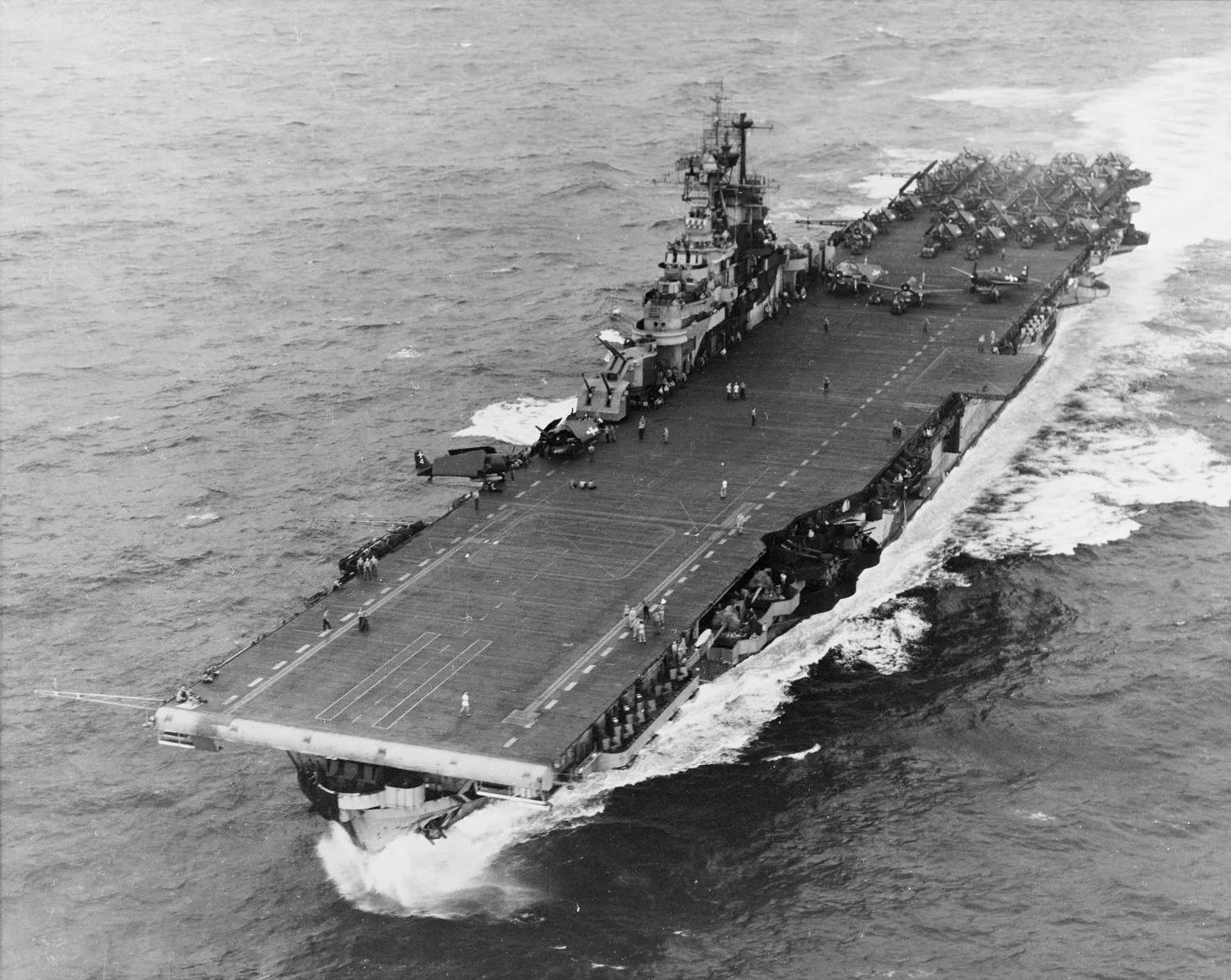
Archival photo of the USS Intrepid operating in the Philippine Sea in November 1944.
Official U.S. Navy Photograph, from the collections of the Naval History and Heritage Command.
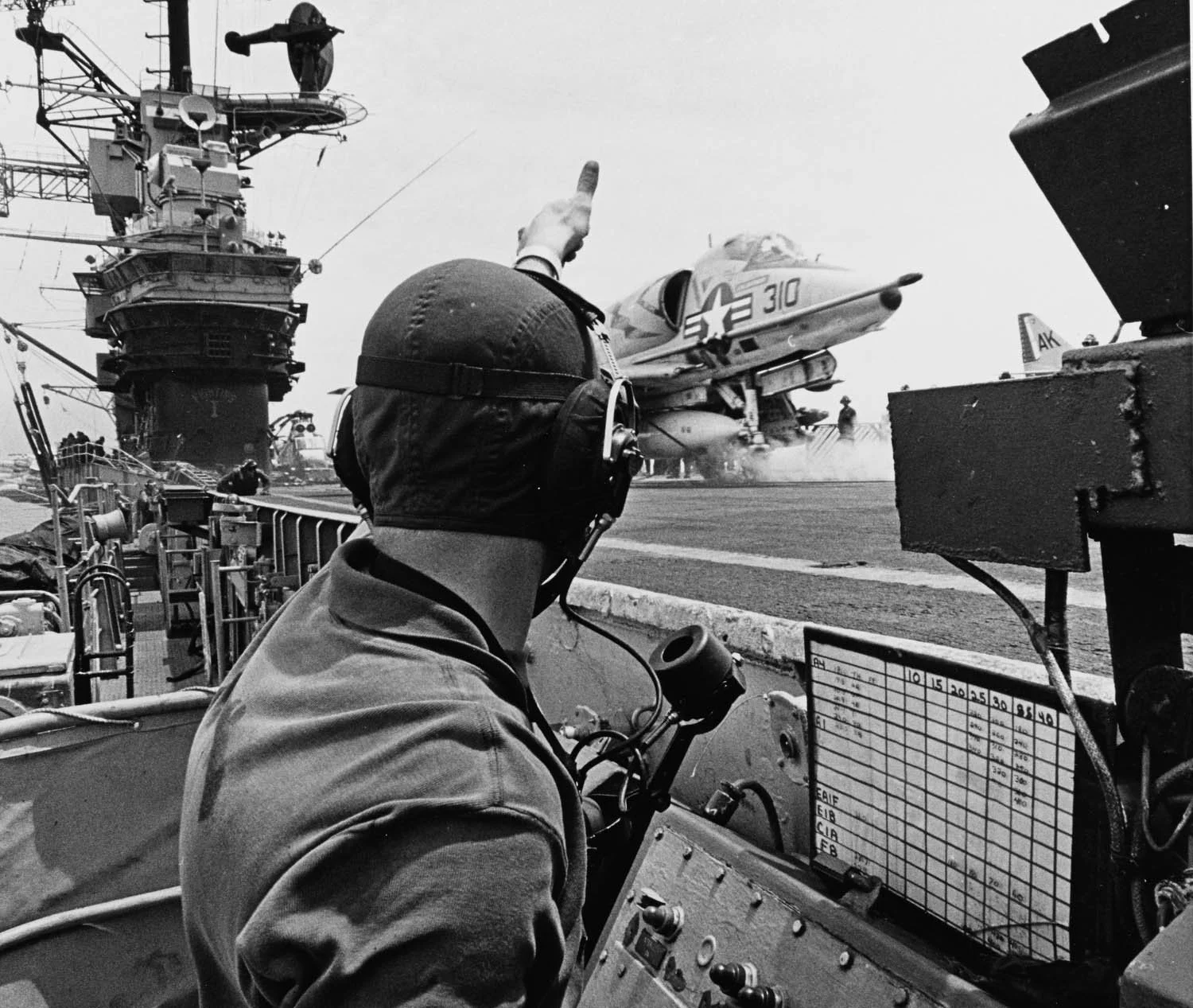
A A-4 Skyhawk attack plane on the starboard catapult during flight operations in the Gulf of Tonkin in September 1968.
U.S. Navy photo courtesy of Naval History and Heritage Command.
Before you visit, it's worth knowing a little about what you're actually stepping onto.
The Intrepid was commissioned during World War 2 in August 1943 and went straight to the Pacific.
She fought in some of the biggest naval battles of World War 2, including the Battle of Leyte Gulf. Over the course of the war, she survived five kamikaze attacks and a torpedo strike. Each time, her crew patched her up and got her back into the fight. That stubbornness earned her the nickname "the Fighting I." It also earned her a less flattering one: "the Decrepit," thanks to all the time she spent in dry dock for repairs.
After the war, she was modernized and returned to service during the Cold War and later saw action in Vietnam. Then her role changed entirely. In 1962, she recovered astronaut Scott Carpenter after his Mercury capsule splashed down in the Atlantic. In 1965, she recovered Gus Grissom and John Young after the Gemini 3 mission.
An aircraft carrier that fought through World War II ended up pulling NASA astronauts out of the ocean. That is quite a biography.
She was decommissioned in 1974 and became a museum ship in 1982. Today, she's a National Historic Landmark, sitting right on the Hudson River in midtown Manhattan. When you walk her flight deck, you're standing on the same deck that launched fighter planes in wartime and recovered space capsules during the space race.

The Intrepid flight deck houses many aircraft.
Exploring the flight deck
There are 28 restored aircraft on the ship, most of them up on the flight deck. The collection spans the full arc of American military aviation, from World War 2 propeller planes right up to Cold War jets and modern helicopters.
When I visited the USS John F. Kennedy while it was conducting real flight operations, the flight deck was an incredibly dangerous spot. Visiting the USS Intrepid Museum is the complete opposite: totally safe and fun.
A few planes are worth singling out. The TBM-3E Avenger is a torpedo bomber that actually flew from the Intrepid during World War 2. Standing next to it and then looking up at the Lockheed A-12 nearby tells you everything about how fast aviation changed in the span of twenty years. The A-12 was a CIA spy plane that could cruise above 80,000 feet and outrun virtually anything that tried to intercept it. The contrast between those two aircraft alone is worth the price of admission.
There are also Soviet MiG fighter jets on display, which always surprises people. One of them, a MiG-21, was a gift from Poland in 1991 and was recently fully restored by the museum's aircraft restoration team.
Don't skip the Island, the tower structure that rises above the flight deck. You can go up to "vulture's row," which is where crew members watched flight operations, and then walk through the navigation bridge with its original radar consoles, chart tables, and the captain's quarters. The view of the Hudson River from up there is one of the better views in the city.

A cruise ship (rear) docked near the Intrepid.
Exhibits below deck
Once you head below, the feel of the visit changes completely. The flight deck is all about hardware. Down below, it becomes much more personal.
The Gallery Deck sits between the flight and hangar levels and houses the Combat Information Center, where crew tracked every aircraft and ship in the area using original radar scopes and plotting boards. Right next to it is the Squadron Ready Room, where pilots received their final briefing before launching. The chairs are still there. The helmets and flight gear are still laid out. It's a quiet space and an easy one to walk past, but worth slowing down for.
Down on the Hangar Deck, the kamikaze multimedia presentation is the highlight for most visitors and shouldn't be missed. The lights, steam, and audio recreate one of the actual attacks the ship survived, at the exact spot on the ship where it happened. It's genuinely affecting.
The Exploreum is the interactive space on the hangar deck. The museum markets it toward families and kids, which is fair, but adults get plenty out of it, too.
You can climb into a real Bell 47 helicopter, sit in a cockpit, or lie in a sailor's bunk and get a real sense of how little space 3,000 crew members had to live in. The flight simulators are here as well. I'll be honest, I've watched people do the G-Force simulator, and it looks intense. One of them simulates flying with the Blue Angels.
There's also an Apollo 11 VR experience if you want to add that on for an extra charge.
Further down on the Third Deck are the fully restored mess hall and berthing areas. The mess deck was remodeled in 1969 and still has its original paint scheme and Western-themed decor, which is a genuinely strange and charming detail. The berthing areas show just how tightly 3,000 sailors were packed into this ship. After the spaciousness of the flight deck, the lower decks give you real respect for everyone who served on her.
Visiting the Space Shuttle Enterprise

The Space Shuttle Enterprise is a highlight at the USS Intrepid.
Perhaps the best and certainly the biggest attraction is the Space Shuttle Enterprise.
The Enterprise has a fascinating story of its own. It was built as a prototype and never flew in space. It has no engines and no heat shield. What it did do was prove the entire shuttle design worked.
In 1977, NASA needed to know if the shuttle could actually glide to a landing after returning from orbit. So they mounted the Enterprise on top of a modified Boeing 747 and flew it up to altitude.
Then they let it go. Astronaut Fred Haise, who had survived the Apollo 13 crisis seven years earlier, piloted the first free flight on August 12, 1977. The shuttle separated at around 24,000 feet and glided to a landing at Edwards Air Force Base in California. They did it five times in total. Those tests proved the design was sound and cleared the way for Columbia to fly the first real mission in 1981.
One more thing worth knowing: the Enterprise was originally going to be named the Constitution. Star Trek fans organized a letter-writing campaign to President Gerald Ford asking him to name it after their starship instead. Over 100,000 letters arrived. Ford agreed.
After years in storage and then on display at the Smithsonian's Udvar-Hazy Center in Virginia, the Enterprise was flown to New York in 2012 on the back of a 747.
At the time, I was still working as a newspaper photographer. I photographed the shuttle flying over the Hudson River that day. The crowds along the waterfront were enormous.
Side Note - Debbie and I are on a quest to see all the surviving space shuttles. We’ve seen Enterprise in NYC and Virginia, Endeavour in Los Angeles, and Atlantis at the Kennedy Space Center in Florida. The only one we haven’t seen yet is Discovery which took the place of Enterprise at the Air and Space Museum in Virginia.

My photo of the Space Shuttle flying over the Hudson River as it is delivered to the Intrepid Museum. People lined both sides of the Hudson River to watch the Space Shuttle fly by. After landing in New York, the Space Shuttle was floated on a barge to the USS Intrepid.


The British Airways Concorde
Sitting on the flight deck near the Space Shuttle Pavilion is something that stops most visitors in their tracks: a full-size Concorde. Not a replica. The actual aircraft, tail number G-BOAD, on loan from British Airways.
This specific plane made its first flight on August 25, 1976, and flew passengers across the Atlantic for nearly 27 years before the entire Concorde fleet was retired in 2003. It cruised at 1,350 miles per hour at an altitude of 60,000 feet, high enough that passengers could actually see the curvature of the earth through the windows. A typical transatlantic crossing took under three hours. Today's flights take about seven.
The story of why Concorde stopped flying is worth knowing before you visit. A crash on takeoff in Paris in July 2000 grounded the entire fleet. British Airways and Air France brought it back in 2001, but confidence never fully recovered. Two years later, both airlines retired their fleets. The plane was a technological marvel that the world simply moved on from.
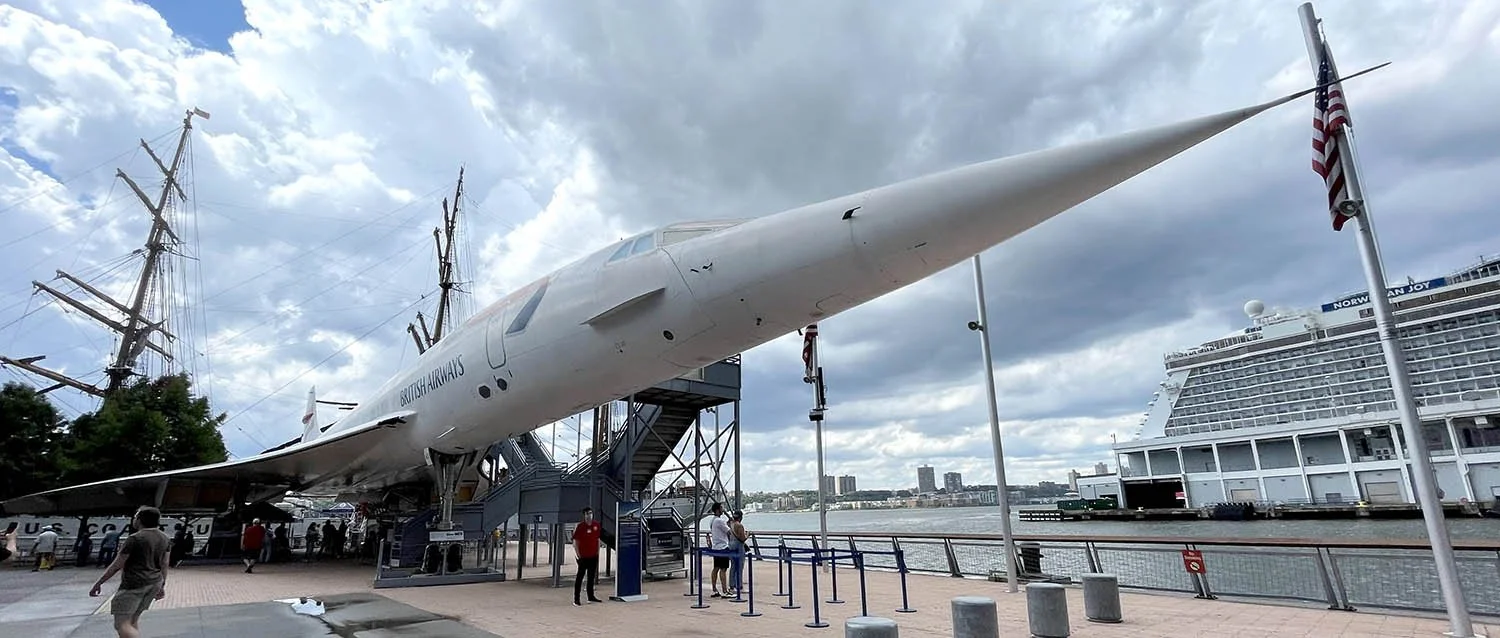
Walking under the British Airways Concorde
This is also the only British Airways Concorde on display anywhere in the Northeast, which makes it genuinely worth a detour even for visitors who aren't aviation fans.
With general admission, you can walk around the plane and get close to the landing gear, which is impressive enough on its own. The museum now offers a guided 20-minute tour inside the cabin and cockpit for $15, running every 30 minutes starting at 11:00 am. When Debbie and I visited, going inside was part of the general experience. The format has since changed, but what you see inside is the same.
The most striking thing we noticed is how tight the cabin is. The seats are narrow, the windows are tiny, and there is very little room to move around. This plane was built for speed, not comfort.
A ticket on Concorde cost the equivalent of thousands of dollars in today's money, and the passengers sitting in those cramped seats paid every bit of it just to get across the Atlantic in three hours.
Walking out, I couldn't help thinking what a shame it is that it no longer flies. A flight from New York to London in the same time it takes me to get to Florida from New York City would be pretty remarkable. Maybe someday.
The USS Growler Submarine
Docked right next to the Intrepid is the USS Growler, and it's included with your general admission ticket. The Growler is the only American nuclear missile submarine open to the public anywhere in the country. That alone makes it worth your time.
The Growler was commissioned in 1958 at the height of the Cold War. Her mission was to carry nuclear-armed cruise missiles close enough to the Soviet Union to launch them if ordered. The crew lived and worked with that reality every day, submerged in an extraordinarily confined space.
Inside, you can walk through the control room, where three crew members steered the sub using the original equipment, with two periscopes still in place.
From there, you move through the crew's mess, a tiny kitchen that fed 100 men, and the torpedo rooms at the front and back of the boat. Crew members actually slept in the torpedo rooms, with bunks wedged in around the tubes. That detail tends to stop people cold.
A few practical things worth knowing before you go. You need to be at least 40 inches tall to enter. The hatches are tight, and you'll be climbing through them, so if you have any concerns about confined spaces, it's worth thinking about beforehand. Strollers, large bags, and backpacks aren't allowed inside. The line can get long on weekends, so we always recommend doing the Growler early in your visit.
There is so much to see on board the USS Intrepid. Debbie and I either ran out of time or were exhausted on our visits and have yet to make it inside. The Concorde and the shuttle get most of the attention, but the Growler sounds like the experience that really stays with people.
Of course, there is a large gift shop near the exit with a huge variety of items. There is also a cafe, but since you are in the middle of NYC, I’d skip it and head to any of the dozens and dozens of nearby restaurants.
You might want to check out our post about what to do in the Chelsea section in NYC , it’s an easy walk from the USS Intrepid. Or you might want to walk east on 42nd Street and follow our blog post about mid-town NYC attractions.
Whether you are a bit obsessed with aircraft carriers and aviation in general, like I am, or just looking for a fun afternoon, the USS Intrepid is a great stop. Not many New York City attractions will hold the attention of young children or senior citizens as well as the Intrepid.
About the Authors

|
John and Debbie O'Boyle are the team behind The Empty Nest Explorers. John is a professional photographer whose work has been published by The New York Times, NBC News, and Getty Images. He is a member of the American Society of Media Photographers, has been part of a Pulitzer Prize-winning team, and has received two New York Emmy nominations. Debbie is a writer with 30+ years of professional photography experience, formerly with The Star-Ledger and NJ.com. Together, they create in-depth travel guides for couples and empty-nest travelers who want to make the most of every destination. |
Other New York City travel blog posts you might like:











Debbie and I are in Manhattan most weeks, for work and to visit our son, and we still love showing people around.
Here are our honest picks for the best things to do, the ones worth your time, the few we would skip, and how to see the city without cramming your days.